• Backstage at Ignite Phoenix

    I had the pleasure of speaking at Ignite Phoenix #5, and I fell in love with the organization. My role at Ignite Phoenix has always been backstage. I was a runner at Ignite Phoenix #6 and I’ve been the assistant stage manager since Ignite Phoenix #7. I’ve volunteered at every Ignite Phoenix event since 2010 with the exception of Ignite Phoenix After Hours #2.

    One of the few pictures of Andy and I holding still at Ignite Phoenix #12; photo by Devon Christopher Adams

    I love working at Ignite Phoenix. Andy Woodward is our stage manager and we have running the show down to a science. The show starts at 6:30pm which means the core team has to be at the venue usually by 3pm to start setting up. Andy and I spend most of that time in the theatre. We draw a box on the stage in tape so our performers know where they have to be seen by the video camera. We set up the confidence monitor – a screen that shows the performers what’s on the screen behind them. We work with the venue’s crew to set the lighting and sound levels and to determine which performer will use which microphone. We also set up the area backstage so our performers are comfortable when they’re not on the stage.

    I’m a big fan of the mantra “Be prepared,” so my bag backstage is full of all kinds of stuff I or a presenter might need like my clipboard, pens, highlighters, Sharpies, mini flashlight, safety pins, caffeine, ibuprofen,  Kleenex, my lucky handkerchief, and my Swiss Army knife.

    A little over an hour before the show our performers arrive and we take them through their orientation. We want them to be comfortable with the stage, backstage, their green room, and we tell them for the first time what order they will be in during the show.

    During the show, Andy is at the edge of the stage making sure that each performance goes well and he does the final prep with each performer right before they go on stage. I’m in charge of most of everything else backstage. It’s my job to put the microphones on and take them off of each presenter and to keep track of everyone when they’re backstage.  I’m constantly counting heads, making sure I know where everyone is.

    It’s my job to be there when presenters need me and to stay out of their way when they don’t. I respect each person’s need to do their own thing when they’re nervous. It’s fun to watch who paces, who reads through their notes, who brings their laptop to go through their slides, and who hangs out in the presenters’ green room downstairs. I want each presenter to feel excited and secure when they step out onto the Ignite stage. I try to instill a sense of calm confidence when I’m putting on their microphone and congratulate them when they finish.

    I’m really looking forward to Ignite Phoenix #13. We have an incredible cast, an awesome team of volunteers, and amazing people at the Scottsdale Center for the Performing Arts who help make it all possible.
  • First Yarn Bomb – Three Weeks Later

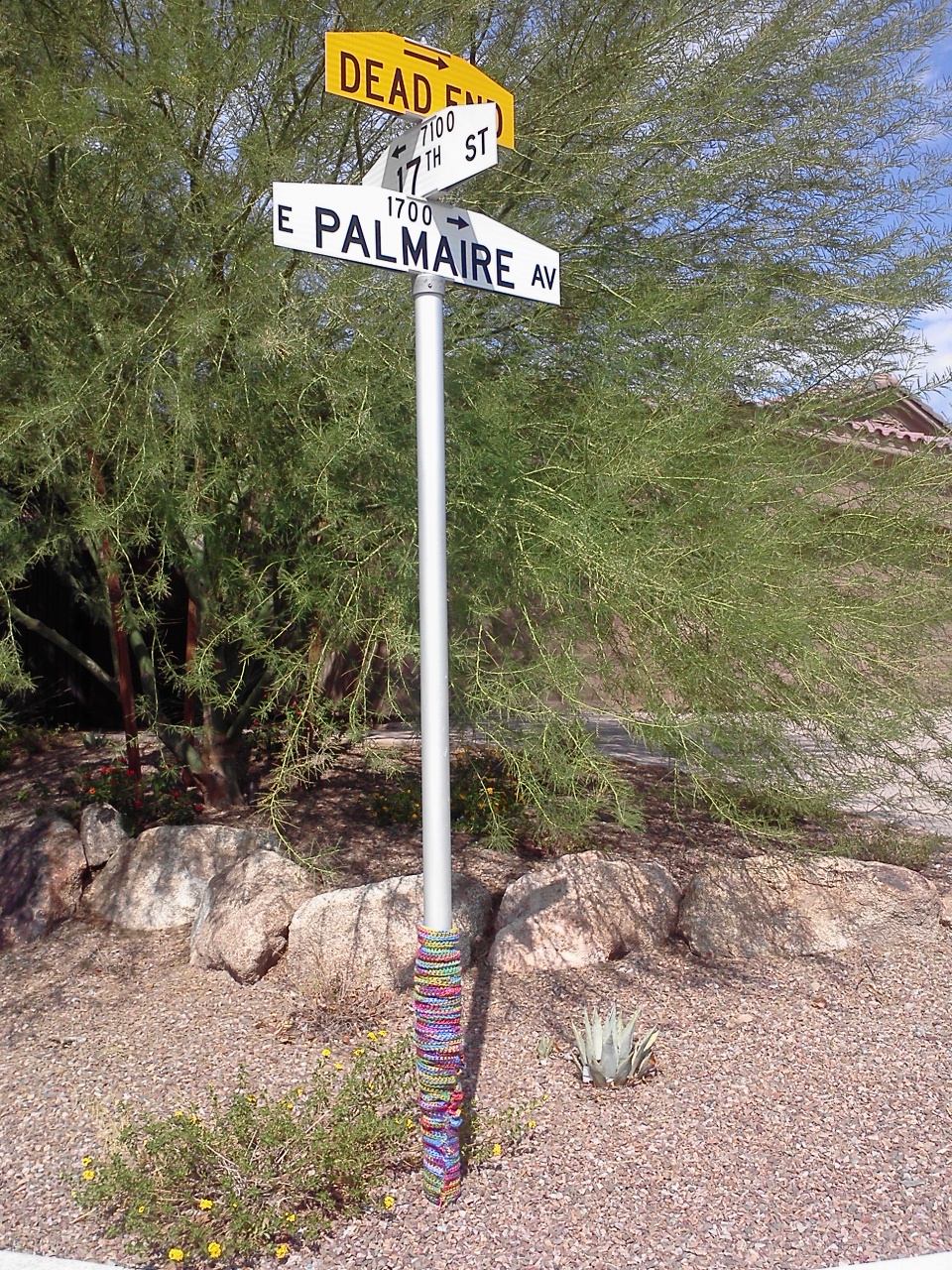
    Much to my surprise, my first yarn bomb project is still up . . . technically. My beautiful yarn sleeve for this post started out snuggly wrapped around the post. Then gravity took hold and pulled the sleeve to the ground. Then it started slumping down the pole, aided partially by some rainstorms. Now it looks like the post is wearing a leg warmer instead of a sleek sweater. But it’s still there!

    I’m surprised no one in the neighborhood has decided it’s an eyesore and cut it down. For me it’s become a question of how long will they leave it there. I see it every day when I walk my dog. The yarn is 100% acrylic so I don’t think it’s really at risk of growing mold or fungus. We’ll see how long it lasts.

    I’ve learned a few valuable lessons from this experience.

    1. If you put a yarn bomb in an area that doesn’t get much foot traffic, it’s likely to stay up longer. It’s on a corner and not directly in front of anyone’s home so I think it’s less likely that someone will take offense to it being there.
    2. When you sew the seam of your yarn bomb, do it as tightly as you can. Consider using multiple shorter pieces of yarn instead of one long piece to do the seam. Yarn stretches over time and will loosen, causing your project to fall.
    3. If you’re yarn bombing a metal object, consider using magnets to help hold your project in place.
    4. If you want your yarn bomb to stand out, pick obnoxiously bright yarn. I thought this yarn was bright enough, but I think it had too many earth tones and blended in to the surroundings too much.
    Yarn Bomb #2 In Production

    I’m already working on my next yarn bomb. It will be in the Scottsdale Civic Center Park next to the Scottsdale Center for the Performing Arts on October 26th, the same day as Ignite Phoenix #13. This project will be a challenge because I’ve selected a tapered lamp post. I measured the diameter post as its base, the diameter as high as I could reach, and the distance between them. My plan is to create a rectangle based on the larger diameter and the height and to overlap my project to account for the tapering of the pole. The result will be a diagonal seam running down the post. I’m looking forward to seeing this final project.

    Enhanced by Zemanta
  • First Yarn Bomb!

    I did my first yarn bomb this week!

    For those of you who don’t know, yarn bombing is a type of public art where you knit or crochet a cover for an object. I think it’s so whimsical and charming.

    My crochet skills are limited, so I only feel comfortable yarn bombing objects that can be broken down into a rectangle or a combination of rectangles. I decided to yarn bomb a street pole for my first project. I picked this because the pole is a uniform cylinder which is essentially a rectangle with the sides sewn together.  I also picked this over a stop sign because stop signs in my neighborhood have reflective tape on the post and I didn’t want to be accused of interfering with a traffic sign or causing a safety hazard by covering it up.

    I measured the pole one day while it was still dark out. I didn’t want arouse suspicion by measuring the diameter when others would see me. I selected a colorful variegated yarn. I wanted the final product to stand out and look cheerful. Then I crocheted a large rectangle to fit the dimensions of the pole.

    My project was done months ago. I didn’t want to put it up to have it be immediately rained on during the Arizona monsoon season. I had a few failed attempts at putting it up. This was a simple project to hang. I just had to wrap the rectangle around the pole and sew up the seam. The first time I tried to do it, I didn’t think to consider the length of the yarn I was using to sew the seam and it got tangled with itself. The second time around, I made the length shorter, and it was still too long. It was also 3am when I tried to hang it, so that probably contributed to a lack of hand-eye coordination.

    I finally got my project hung this week. I put it up at 7pm – after sunset but not quite dark. I live in a quiet neighborhood so few people saw me, and those who did, didn’t seem to care. I was really pleased with how it came out. The biggest lessons I’m taking away from it is selecting a length of yarn to sew the seam that’s twice as long as the project itself was a good length to work with, I could cover a few inches with every stitch sewed, and it’s important to pick a bright color of yarn so the completed project stands out from the surroundings. I thought I picked an obnoxious color of yarn, but next time I’m going for something even brighter.