• Disclaimer: I am not a lawyer. I am a law student. In accordance with ABA policy, this blog should not be viewed as legal advice. It is simply my experiences, opinions, and stuff I looked up on the internet.
    First Amendment
    Image by NomadicEntrepreneur via Flickr

    Thanks to the First Amendment, we have the right of free speech in the United States. There are limits on free speech  regarding the time, place, and manner of the speech which is why we can’t shout “Fire!” in a crowded theatre. The First Amendment also doesn’t protect obscenity or libel.

    Speech on the internet is generally protected, including anonymous speech. I don’t understand why people want to speak anonymously in this public forum, but the law protects it.

    Americans are very quick to sue people they don’t like, so the real question is, can I be sued and lose because of my blog? A quick search on the database and Google has revealed that bloggers have been successfully sued for their blogs.

    Defamation and Libel
    Based on case law I read, a blogger can be sued for defamation and libel if they use their blog to make false statements about a public figure. The courts seem to apply a broad definition to “public figure.” If the public figure the blogger talks about in their blog can show that the blogger made a false statement about them and that the statement was made with “actual malice,” then they have a valid claim for defamation and libel.

    Conversely, a blogger’s personal opinion is protected by the First Amendment. It’s only when they are making statements of fact or a combination of fact and opinion that they have to be concerned that they could be sued if they are publishing false statements.

    Copyright Infringement
    A person gets a copyright if they create an original work of authorship that is fixed in a tangible medium. They don’t have to register their work in any database; they just have to create it. Therefore, bloggers should own the copyright for all their posts, unless they previously gave up their copyright rights to someone else. If a blogger posts someone else’s material and claims it as their own, that’s copyright infringement. Writing about the same ideas is ok; stealing someone’s verbiage is not.

    I don’t know why anyone would do this – isn’t the purpose of having a blog to express your own views and ideas? I suspect few bloggers are policing the internet looking for people infringing on their work and most aren’t equipped with the resources to file a claim against another blogger for stealing their work. I’m fine with people stealing my verbiage for their blog as long as they include a link back to this site. My guess is most bloggers are equally fine with others quoting them as long as they get the attribution.

    You Can Be Sued for Your Comments – Not Sure If You Can Lose
    Aaron Wall was sued by Traffic-Power.com when negative comments about the company appeared on Wall’s website, SEOBook.com. Wall opted to remove the comments about Traffic Power instead of spending his time, energy, and money to fight the lawsuit.

    I don’t know what the comments about Traffic Power said, but it makes me wonder if other companies will threaten lawsuits against bloggers to remove negative comments about themselves online. Most bloggers probably won’t want to go through the time and hassle of fighting the suit, even when the comments might be protected by the First Amendment. Even if there wasn’t a valid case in this situation, it should serve as a reminder that bloggers are responsible for the comments they allow to be posted on their sites.

    Reblog this post [with Zemanta]
  • Unsolicited Advice: Think Before You Post

    Disclaimer: I am not a lawyer.  I am a law student.  In accordance with ABA policy, this blog should not be viewed as legal advice.  It is simply my experiences, opinions, and stuff I looked up on the internet.

    Laptop at a Cafe
    Image by workshifting via Flickr

    Never before has Bill Wilson’s advice, “Nothing pays off like restraint of pen and tongue” been more appropriate.  In the past, we expressed how we felt mainly in-person or via phone calls.  If something was important enough to write about, it took time to draft a letter or write an article.  Now with email and social media sties, we can jump on our proverbial soapboxes whenever the feeling moves us and blast our opinion to the universe from anywhere.  More than ever, it is essential to think before we send an email, update our Facebook status, post a blog, or tweet – because it’s permanent!!!

    I will never cease to be amazed by what people say in email or post online.  A quick glance at my friends’ profiles revealed a smattering of pictures of people getting drunk and posts filled with hateful language.  For the most part, these aren’t stupid people, but they have done stupid things – and documented it.  It immediately reminded of what my Dad says: “You can’t coach dumb.”

    It seems lately that people need to be reminded that there is a permanent record of every single email they send. Even if you delete all of your “sent items,” they are still backed up on a server somewhere, and probably backed up on the receiver’s server too.  Therefore, “if you are dealing with something that could come back to bite you later, pick up the phone, or better yet, go talk in person, but avoid email.”  Don’t leave a paper trail.

    And don’t think that deleting your Facebook account will remove all the evidence of any past wrongdoings you posted.  Deleting your account, doesn’t actually delete it.  It just makes it inaccessible to other users.  It’s still in the database. What’s even more frightening is that I’ve heard a rumor that employers are hiring hackers to tell them what’s on job applicants’ Facebook and Myspace profiles.  Don’t assume that changing your privacy settings will protect you.

    Too many people treat email and social media sites like casual conversation, but worse because they ignore the fact that they are writing to and about real people.   The fact that the sender doesn’t have to look the person in the eye seems to lower their inhibitions and remove the filter that ordinary blocks them from saying everything that they think.  The result is abusive behavior and harassment.

    Cyberstalking, cyberbullying, and/or cyberharassment are crimes in 41 of the 50 states.  In Arizona, cyberharassment is a Class 1 misdemeanor, punishable by up to six months in jail, and/or a $2500 fine.  Often when the perpetrator is a minor the crime is cyberbullying.  When the perpetrator is an adult, it’s cyberharassment.  The behavior is the same, just different names.  The courts have allowed lawsuits to be filed in criminal and civil court related to these acts.

    Here’s my two cents when it comes to electronic communications: if you feel the need to vent when you’re upset about something, the way to do it without getting in trouble is to simply say how you feel about it.  When I say, “I’m frustrated,” no one can say that that’s inappropriate or that it isn’t true.  It’s a feeling, the fact of my mental state.  You may have a different reaction, but neither person is wrong.  It’s how we act on them that gets us into trouble.

    So think whatever you want.  Be careful about what you say.  But assume everything you say electronically, regardless of where you post it, is viewable by the general public and will follow you for the rest of your life.  Don’t send anything via email or post anything online that you wouldn’t want your family, friends, co-workers, or employers to see.

    Enhanced by Zemanta
  • Disclaimer: I am not a lawyer.  I am a law student.  In accordance with ABA policy, this blog should not be viewed as legal advice.  It is simply my experiences, opinions, and stuff I looked up on the internet.

    Last week the Improv AZ crew decided to revise their world –famous coroner prank, only this time instead of having four people in “coroner” shirts carry a stuffed body bag on the light rail, we took it for a walk through Chandler mall.

    We were hoping to raise a lot of eyebrows and get a lot of double takes and surprised stares of disbelief.  We succeeded in that, but we also spent just enough time in the building to get the attention of mall security.  Not wanting to cause any trouble, we offered to leave.  They refused our offer and called Chandler Police instead.  A mall cop claimed we committed “a dozen felonies.”  The real cop said we could have been charged with disorderly conduct.  In the end, they let us go with a warning and the mall cops banned us from Chandler mall for three months.

    Of course as the group’s CLS, I did my usual research before doing this prank, and after our run in with the law, I rechecked everything.

    What can mall cops really do?

    Mall cops are citizens and can only make citizen arrests.  If they are an agent of the property owner, they can ask people to leave and call law enforcement to arrest them for trespassing if the patrons don’t comply.

    Did we commit trespassing?

    I don’t think so.  Shopping malls open themselves up for members of the public to enter and shop.  We are, in legalese, “invitees.”  If we had been asked to leave by a property owner or their agent and then refused to go, then we would have been trespassing.

    Were we illegally impersonating a government official?

    The way Arizona law is written, we would have to pretend to be a public servant and engage in conduct “with the intent to induce another to submit to [our] pretended official authority or to rely upon [our] pretended official acts” to be charged with impersonation.  We did nothing to assert our authority against any mall patrons or anyone else.

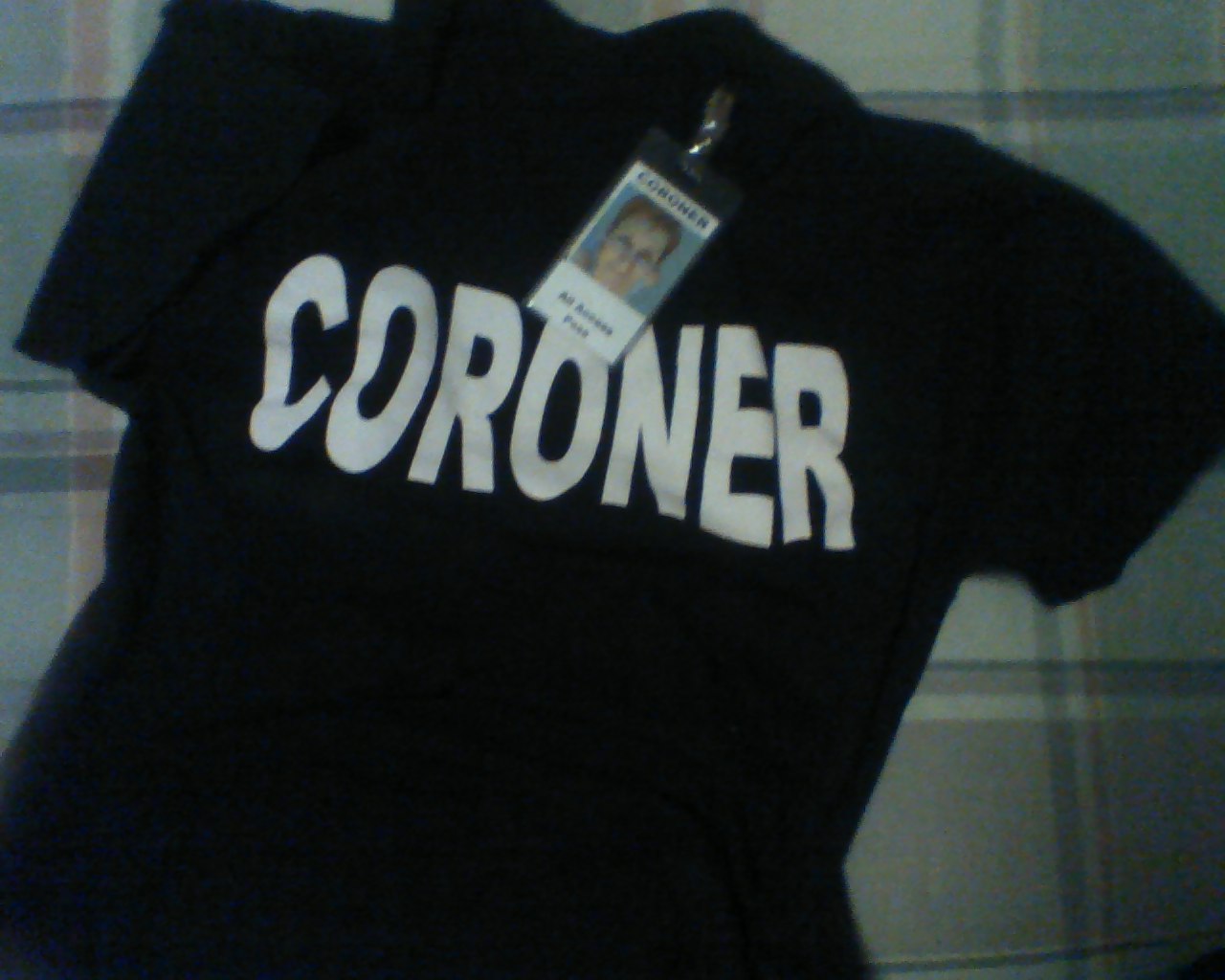
    A mall cop tried to tell us that our fake coroner badges made us guilty of a felony, but anyone looking closely at them would have seen that they were made with someone’s laminator at home.  Our badges had our pictures – mine was my Twitter avatar – and the words “Coroner” and “All Access Pass.”  The mall cop took our badges from us and turned them over to the Chandler police officer.  After looking at them briefly, he gave them back to us.

    FYI – Arizona doesn’t have coroners.  It has medical examiners.

    Did we commit disorderly conduct?

    I think that’s a stretch at best.  Arizona law defines disorderly conduct as engaging in certain behavior “with the intent to disturb the peace or quiet of a neighborhood, family, or person or with the knowledge of doing so.”  The only behavior they could have tried to pin on us was “fighting, violent or seriously disruptive behavior.”   Our conduct could have been considered disruptive, but probably not deserving of being in the same category as violent behavior.  The other behaviors on the list for disorderly conduct didn’t seem to apply since we weren’t making noise, using offensive language, carrying weapons, or preventing business transactions from occurring.

    Could the mall cops make our camera guy prove he’d erased the footage he shot with his phone?

    Mall cops are just civilians so they probably don’t have that authority.  Real cops, however, can search your phone if it’s related to an arrest.  Otherwise, it looks like they’d a search warrant.

    Is it illegal to walk around with a fake dead body?

    I looked through Arizona statutes and didn’t find any laws against having fake dead body.  I find out about some of the things you can’t do with an actual dead body:

    • You can’t move a dead human body with the hopes of abandoning or concealing it.
    • You can’t move a dead body from its grave without authority of law.
    • You can’t steal stuff off or from a dead body.
    • You can’t have sex with a dead body.

    For now the four coroners are banned from Chandler mall.  The mall cop gave each of us a card with the Chandler mall code of conduct on it.  I’d share this list with you (it’s pretty funny) but it’s too long, and surprisingly, Chandler mall doesn’t have it available on their website.

    Related Articles:
    Official Improv AZ Blog: When Mall Cops Swarm – The Coroner Prank #2
    Video: Improv AZ – Coroner Prank 2, “Bob Goes To The Mall”