• Ironman Lake Placid – Your Questions Answered

    Thank you for being part of my journey to become an Ironman. I hope you’ve enjoyed the other posts to date that highlighted the 2.4-mile swim, the 112-mile bike, the 26.2-mile run, and the numerous supporters who helped me along the way. Now it’s time to answer your questions:
    What Made You Start Doing Ironman Races?

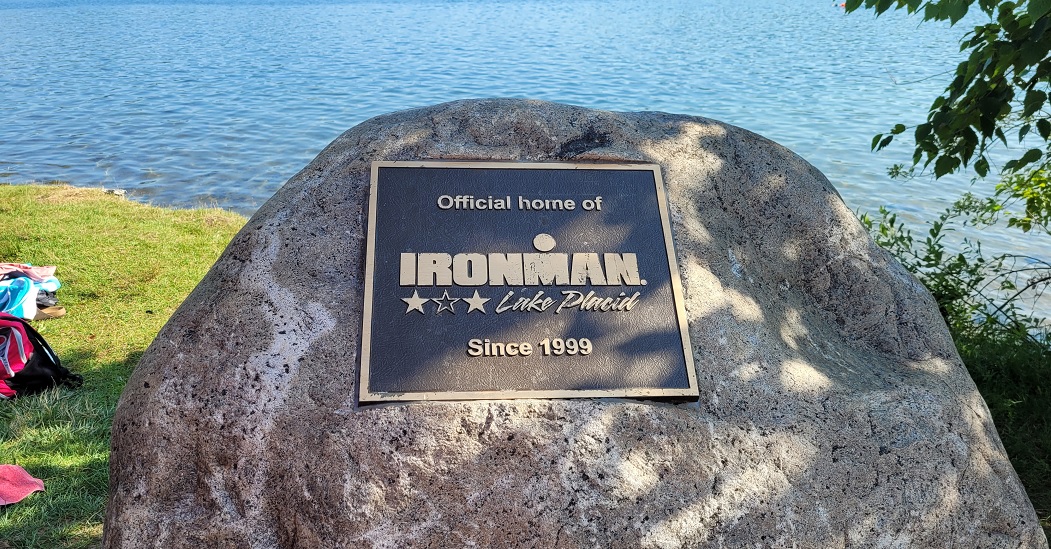
    Coach David is certified in train people to do running races and triathlons. After I completed my first marathon, I said I wanted to cross train with swimming and biking. That led to me signing up for a sprint triathlon in 2018 to see if I liked doing all three activities consecutively.

    About 10 seconds into that race, I thought, “Yeah, I like this.” Once I finished that race, I signed up for and competed in my first Half Ironman in Maine in 2019. That was also the first race I did with my coach. I went into that race with the plan that if I liked the Half Ironman that the next step would be to do the full.

    What is the Cut Off Time for Each Segment?

    Swim: 2 hours, 20 minutes after the last swimmer enters the water

    Bike: 5:30 p.m.

    Run: 17 hours or midnight

    Did You Have a Time Goal for Each Segment or was the Goal to Finish with Little Regard for Time Other Than to Make the Cut Offs?

    My goal was to finish within 17 hours. I didn’t have any goals for each segment.

    What was Your Strategy for Preparing for this Race that Wasn’t in the City Where You Live?

    Most of my swim training was in the pool and not in a lake, but that’s probably true for most racers. Two days before the race, my coach took me for a practice swim in the lake where we’d be racing so I could get comfortable with the water and the guide cable.

    The Lake Placid bike course is notorious for its hills. Earlier in my training, I did my long rides at South Mountain where the inclines were as steep as Lake Placid, but not as long. As it got hotter, I had to do my bike rides closer to home because I couldn’t logistically make it work to get up, drive to the mountain, and do my workout before it got too hot.

    I had the same issue with running. For my long runs, I had to do loops where I regularly stopped at home to refill my Gatorade and drink extra water because it was so hot. I regularly ran hills because the Lake Placid run course was also quite hilly, but the shorter hills closer to home were more than sufficient.

    We knew my longest training days would be hotter but less humid than Lake Placid. Part of why I arrived days before the race was to adapt to the time change and get used to the humidity.
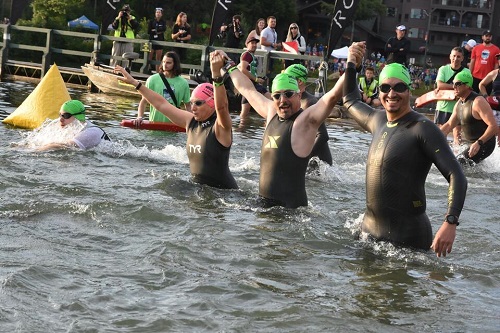
    Team Roher started the race together.

    Did You Get Kicked a lot in the Swim?

    Did I get kicked? Yes – kicked, hit, and bumped. I also ran into a kayak and more than one buoy.  

    I wouldn’t say I got kicked a lot. Taking the inside track had the advantage of keeping me away from a lot of the other swimmers. I wanted to be on the left side of the guide cable, and most people opted for the right side.

    Did You Use Multiple Strokes and Which One was the Dominant One?

    I used freestyle (front crawl) for the entire swim. That’s what I trained with. I saw and passed one swimmer who appeared to be doing the breast stroke the whole way.

    Unlike most races, Lake Placid had a guide cable, so I didn’t have to spot the buoys during the swim. It’s also why I ran into at least two of them. In a race without a guide cable, I could see myself doing mostly freestyle with the occasional breast stroke break to better track the buoys while maintaining forward momentum.

    As a Non-Binary Person, How was Your Experience in the Transition Area?

    The transition area had two changing tents – one for men and one for women. As I entered the transition area during T1 (swim to bike) and T2 (bike to run), there was a different volunteer directing the racers to the tents, saying “Women here. Men down there.”

    Each time, I responded with “I’m non-binary,” and without skipping a beat, the volunteer said, “Use whichever one you want.”

    I doubt the volunteers had training about what to do with non-binary racers because Ironman does not currently offer a non-binary division. Instead, I think their supportive responses were likely due to the volunteers thinking one or both of the following:

    1. I don’t care.
    2. It’s your race. Do whatever you need to do.
    What Socks Did You Wear for Ironman?

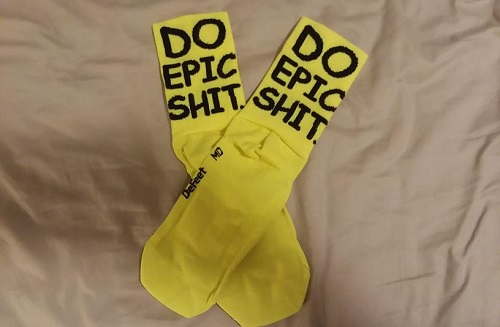
    For the bike, I wore DeFeet 6” cycling socks. For the run, Feetures Elite Max Cushion socks.

    How Were Your Interactions with Other Competitors?

    Super friendly! If you’re racing near me, you’re not there to win. You’re there for the experience and to finish. There was lots of upbeat encouragement between us.

    What Did You do for Nutrition?

    In the final days before the race, I ate as much as I could. In the morning before the race, I had overnight oats loaded with pumpkin seeds, almonds, chia seeds, ground flax seeds, peanut butter powder, protein powder, and raisins. I also had a banana.

    Between the swim and the bike, I had a calorie-bomb cookie. During the bike ride, I had 2.5 scoops of chocolate protein powder in one of my water bottles. I grabbed a fresh Gatorade and half a banana at every aid station. I took a hit of BASE salt at every aid station. I had some gels during the ride too.

    Between the bike and the run, I had some electrolyte gummy candies with caffeine. During the run, I had gels at Mile 5, 10, and 15. I drank Gatorade at most of the aid stations, and I took a hit of BASE salt at each mile marker.

    How Did You Eat Enough?

    You don’t. My coach lost 7 pounds during the race.

    I couldn’t eat right after finishing the race, but once my body settled for a few hours, I was famished!

    How Did You Handle the Heat?

    Pretty well. Starting at Mile 47 of the bike, I dumped a bottle of cold water over my head at each aid station. During the run, I dumped ice into my sports bra at each aid station, and I ran through the “human car wash” each time a spectator set one up for us.

    How Many Moments Did You Want to Quit During the Race?

    None.

    Less than 10 miles to go – still smiling!

    Did You have to Push Through any Walls You Hit, Both Physically and Mentally?

    I never wanted to quit, but there were some challenging moments. The first was right before the race when we were squished together waiting to start the swim. I don’t do crowds well.

    The second challenge was near the end of the first loop on the bike. I took a break at one of the aid stations, tired and frustrated, and I realized I was probably under fueled. Once I bumped up my calories and protein, I felt better. Shifting my mindset to accepting the pain made the second lap much easier.

    At any Time During Training (as opposed to the race itself), Did You Consider Backing Out? If so, How did You Keep on Track?

    No. Once I paid my registration fee, I was committed to race and the training it would take to get to the finish line. It was exceptionally challenging to do my long bike and run workouts in the Phoenix heat, but I pushed through.

    What was Your Biggest Surprise During the Race?

    I don’t think anything can fully prepare you to bike up the Lake Placid hills, particularly how long those climbs are. I trained on hills that were as steep as the Lake Placid hills, not nothing like how long those hills are. During my training, I regularly stood up on my pedals while climbing hills, and early on in the race I learned I go faster when I stay in the saddle.

    Did Your Body Have any Serious Difficulties at any Point such as Cramps or Muscle Tightness that Made Progress Difficult?

    No. By the time I got off the bike, my quads and hamstrings hurt a lot. I couldn’t lift my feet far off the ground. Every step hurt, but I was happy taking each of those steps.  

    At What Point on the Marathon Did You Know, “I’ve Got This?”

    I knew from my first step into the run course. My legs were sore and tired, but I had plenty of time on clock to finish. It was just a matter of putting one foot in front of the other.
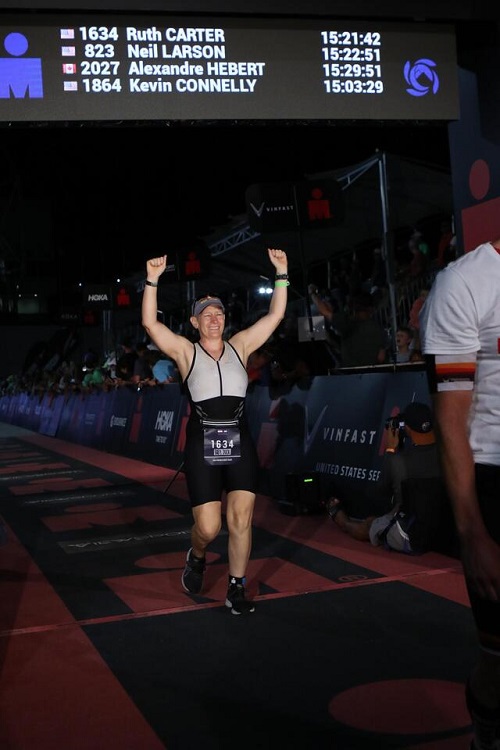
    What was the Last Mile of the Marathon Like Physically and What was Going Through Your Mind?

    By the last mile of the run, my legs were exhausted. I only ran when the course was flat or going downhill and walked every incline.

    What was going through my mind? I was excited to cross the finish line and achieve this massive goal of becoming an Ironman. It was a bit overwhelming. I’d worked so hard for years, and this moment was finally here. As I crossed the finish line, I burst into tears, overwhelmed with joy and relief.

    Being Non-Binary, Does the Gender Specific Name “Ironman” Bother You?

    No. Ironman is a brand.

    I’ve had people refer to me as an Iron Person, and I correct them saying, “I’m an Ironman.”

    I already have the M-dot keychain!

    Are You Going to Get the Tattoo?

    Of course! I plan to put a variation of the M-dot on the back of my calf.

    Are You Going to do Another Ironman?

    There’s a good chance. I’m looking at a Half Ironman for 2023 and a full Ironman in 2024.

    Those of my quads – covered with exercise-induced vasculitis.

    What Would You do Differently?

    If I do the Lake Placid Ironman or a race with a hilly bike course, I’ll change my winter and spring long bike workouts to include steeper and longer hill climbs.

    One of the challenges I had with the long run workouts in the hot sun leading up to my race was exercise-induced vasculitis, aka Disney Rash. My legs between the bottom of my shorts and the top of my socks were covered with red splotches. After the race, I learned there are climate controlled indoor running tracks in my community. I will definitely use one of them for my long runs instead of running outside if I do another summer Ironman.

    Do You Feel any Shifts in How You Think About or Carry Yourself After Completing such a Herculean Goal?

    After the race, I started using the mantra, “Fuck you. I’m an Ironman.”

    I only say this in my head, and I don’t use this in an I’m-Better-Than-You way.  Instead, it’s an exultation to mean, “I can do this” when directed toward myself, and I’ve used it to mean “You can’t intimidate me” when directed towards opposing counsel.

    Thank you for following along for my Ironman journey. I hope you enjoyed it!

  • When Your Kid Says They’re Non-Binary

    A few weeks ago, I received a message from one of my classmates from high school that said her child recently came out to her and her husband as non-binary and said their pronouns are they/them. My friend asked how she can educate herself and what guidance I could offer for dealing with relatives who may be less accepting.

    When I responded, I started with, “Oh geez – your life just got a lot more complicated, but in a good way.” I gave her my number and asked her to let her kid know that they have an Oggy Ruth that they can talk to if they need a non-binary grown-up to talk to who “gets it” in ways they’re afraid that others can’t understand. (Oggy is the title I chose since there isn’t a gender-neutral term for aunt/uncle. It rhymes with “doggy.”)

    This button is on my backpack.

    There’s No One Way to be Non-Binary

    If your child was assigned male a birth (AMAB) and they’re actually female or assigned female at birth (AFAB) and they’re actually male, the expected trajectory is more clear and can include a new name, new hairstyle, different clothes, hormones, and gender affirming surgery. If your child is non-binary, it’s best to follow their lead. Invite them to tell you what they need, whether it’s a new name, new hairstyle, or different clothes. They may want some specialty items like a chest binder, stand to pee (STP), or a packer. Ask your child about their thoughts about hormones or hormone blockers. (Hormone blockers didn’t exist when I was a kid, but if I knew I was non-binary back then, I would have wanted them.) They may also want counseling. It’s not easy to navigate a binary-centric world as a non-binary person.

    Ask your child what they need from the institutions in their life. They might need gender neutral bathrooms at school. Some schools won’t address a child by their new name unless you legally change it. Your child may want to have their birth certificate and/or driver’s license corrected. Hopefully, you live in a state where you have that option.

    In regards to resources, I recommended Free Mom Hugs’ resource page. I love this organization, and this page has a wide variety of resources listed. I love seeing people in the audience at the Pride parade who wear t-shirts that say “Free Mom Hugs” and “Free Dad Hugs.” I always try to stop and hug them.

    Dealing with Less Than Accepting Relatives

    As the parent, you are your child’s advocate. Ask your kid how they want to tell the relatives, and as long as it isn’t inappropriate, support it.

    You may have to have a heart-to-heart with a relative if they are struggling to accept that your child is non-binary. They may have known your kid by a different name and pronouns for over 10 years, and adjusting to the new name and pronouns will be hard. Tell them it’s ok if they make mistakes, as long as they’re trying, and they correct themselves when it happens. Give them a chance to practice by talking about your non-binary child with them. (I have a co-worker who is working on using my correct pronouns. I’m tempted to tell him to talk about me with his family to practice.)

    Note: I have a friend who has had a non-binary kid for years. She still occasionally refers to them by the wrong name or pronoun. It’s ok if you or your family doesn’t adapt overnight.

    Your relative may have trouble wrapping their head around the idea that a person may not be male or female. That’s ok too. As long as they respect and accept that your child is telling the truth about who they are, I suspect your relative will be fine in the long run. Here’s my favorite video to share with people who are new to learning about what it means to be non-binary. (It’s also quite validating for me.)

    Whether your child is a different gender or sexuality than what you originally expected (or both), assume there are going to be inappropriate questions. I tell people that it’s fine to ask me all their potentially inappropriate questions as long as their coming from a place of respect and curiosity. There may be times when it’s best to respond with, “I understand that you’re curious, but that’s a very personal question. My kid will talk about that if and when they decide they want to bring that topic up with you.”

    Don’t be Afraid to Go into Mama/Papa Bear Mode

    If you have a non-binary kid, there may be times when you need to go into full-on mama bear or papa bear mode on their behalf. It may be with your child’s school, doctor, a relative, or even the government. Going to bat for your kid validates their experience, even if you don’t get the outcome you want.

    When your child tells you about a frustrating experience as a non-binary person in a binary-centric society, acknowledge it, even when you don’t understand why something is a big deal to them. Their feelings are valid, whatever they are. Hold space for your child so they have at least one place where it’s safe for them to be themselves and explore what their gender means to them.

  • All Genders Deserve Equal Access in Sports

    Arizona has joined the number of states that has proposed legislation that would ban male-to-female transgender athletes from competing in female sports unless they have a doctor’s note that proves that they’re female. This law would impact athletes at every from level from K-12 schools to community colleges and state universities.

    Photo by Ted Eytan from Flickr (Creative Commons License)

    Why We’re Having This Debate

    The surge of proposed laws followed news stories last year where a female track and field athlete claimed that male-to-female transgender athletes were unfairly allowed to compete in the girls’ division. The trans athletes finished a race higher than she did, which she claimed cost her the opportunity to compete at the regional race, which could impact her ability to get a college scholarship.

    What I didn’t like about the reporting of this story is that most reports didn’t state whether the trans athletes were on hormone blockers and/or on hormone replacement therapy which would have made it a more level field than a cisgender male competing in a female sport. By the way, they’re both on hormones replacement therapy.

    School Athletics May be the Only Option

    My first thought when I heard about this proposed law in Arizona, was that trans athletes should bypass political issues in school and compete on club teams. A teacher friend pointed out that club teams are often very expensive, so the only option to participate in sports is to play on a school team.

    Is It Talent or Testosterone?

    Transgender girls are girls. They should be allowed to participate in girls’ activities, whether we are talking about Girl Scouts, entering a nunnery, or playing sports. Forcing a transgender girl to participate in boys’ activities or be left out is discriminatory and potentially devastating to her mental health.

    In the situation of athletics, I wonder how much of is this outcry based on fairness and how much is based on transphobia. Are girls afraid of being beaten by someone they view as less than a girl?

    It’s worth asking how much of these trans athletes’ success is based on talent or testosterone. History suggests that cisgender men have physical advantages over women in many sports. In looking at Olympic Records where men and women both compete in same types of events (e.g., track and field, weightlifting, etc.) the record held by the man is higher, faster, better than the women’s record. That’s why we created Title IX – to give women equal access to participate. But once a trans athlete has the same hormone level as their cisgender counterparts, I wonder if the cisgender athletes are claiming it’s unfair, but they’re using the competitions’ trans status to complain that they didn’t win.

    It’s Time to Re-Examine Division in Sports

    It’s time we re-examine how we divide participants in sports. With growing acceptance that there are more than two genders, which is backed by law in at least 17 states and Washington D.C., the traditional division of boys/men and girls/women is no longer sufficient. I’m a non-binary athlete (with a birth certificate to prove it), and when I sign up for a race, I rename the divisions “testosterone” and “estrogen” and select accordingly.  

    The International Olympic Committee (IOC) has guidelines regarding male-to-female athletes and the testosterone level they must have to compete in the women’s division. Lower level sports should adopt similar rules and require every athlete to have their testosterone level checked, and only those with a level above the threshold should be allowed to participate in the testosterone division.

    (A friend suggested that the athlete’s sensitivity to testosterone should also be tested for it is possible for a cisgender woman to have a high testosterone level and body that is completely insensitive to it, so she won’t reap any athletic benefits from having this higher level.)

    Photo by tableatny from Flickr (Creative Commons License)

    Where Change Should Start

    In thinking about this issue, if we want schools to change how athletes are divided instead of using gender in the U.S., the National Collegiate Athletic Association (NCAA) should be the leader. If NCAA schools change from men’s and women’s sport to divisions based on hormones, public and private high schools will follow suit since many of the best high school athletes aspire to receive scholarships to compete in college.  

    I sent an email to the Chair of the Board of Directors for NCAA Division I, encouraging them to modify the classification of athletes instead of using gender identity. I don’t expect a response beyond a cursory, “Thank you for your message,” but hopefully it will plant a seed that change is needed.

    Sister Laws for Access to Trans Medical Care

    If states are going to pass laws that will limit male-to-female trans athletes from participating in sports, they need to a pass sister laws that allow for adequate and affordable access to medical care for transgender people, including the ability to access care without parental consent, and laws that allow non-binary and transgender people to change their birth certificates and driver’s licenses to reflect their gender.