I knew Rosie wouldn’t make it to the end of the summer this year. Probably starting in June, I could see that her arthritis and canine cognitive dysfunction (CCD) aka doggy dementia were slowing her down. She didn’t want to walk as much, and she didn’t want to go to the office with me. She slept so much that many times I watched her to see if she was still breathing. Each time I went to the grocery store to get her more chicken, I wondered if this was going to be the last time I’d cooked chicken for her.
I told her that if she was done, it was ok to let go. There were many nights I’d look at her laying on her bed and pray, “God, please take her in her sleep.”

Making the Decision
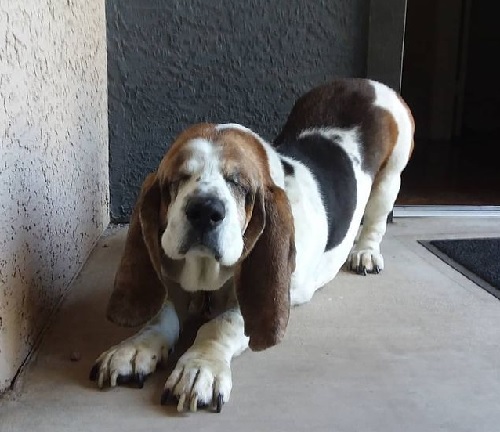
Dogs communicate in their own ways, but the message isn’t always crystal clear. When she started stumbling when she walked, I seriously started questioning her quality of life. About a week before she died, I invited Rosie’s godfather over to see her, knowing it was probably the last chance he’d see her alive. A dog owner himself, I knew he’d give me an honest opinion about how she was doing.
In her youth, Rosie used to bolt around the house and bark like crazy when he’d visit. This visit, she wagged her tail weakly with recognition, but it was obvious her energy wasn’t there. When I asked him what he though, he said, “She’s struggling.”
Looking for confirmation that I was making the right decision, I search online for quality of life assessments. One of my challenges was she was still eating all her meals and finishing mine too. I also called our vet to have the quality of life discussion. As painful as it was, I knew it was time. On Wednesday night, I exchanged texts with a mobile vet and made the appointment for Friday morning at 10 a.m. to send her over the Rainbow Bridge.
Good-Byes with Dog and Human Friends
Rosie and I were lucky to have an amazing group of dog and human friends. I messaged some of them to let them know that Rosie would be passing on Friday and invited them to visit one last time. On Thursday night, Rosie’s Aunt Des and Uncle Mike came over with their dog Phoenix as did Aunt Sarah and Uncle Thomas with their dog Brodie. We let the dogs roam on the grass, Rosie mostly doing her own thing, sniffing around.
When Rosie was done being outside, we went back in the house. The humans sat in the living room while Rosie opted to lay by herself in the hallway. I gave Des a lot of Rosie’s treats for Phoenix since we wouldn’t need them anymore. (They were too big for Brodie’s little mouth.) I don’t remember what anybody said, but it was so glad that everyone got to love on Rosie one more time.
Dying at Home
Friday morning was surreal. I didn’t know what to do while I waited for our appointment time with the mobile vet. I sat on the floor next to her in the hallway, petting her while watching YouTube on my phone. I sang her “You Are My Sunshine” which was the first song I sang to her during our meet-and-greet before her adoption . . . well, I managed to say the words on the song with tears in my eyes. I told her I loved her.
There was a knock at the door at 10 a.m. Tears were streaming down my face as I turned the doorknob to see Dr. Katherine Campabadal. I invited her in and coaxed Rosie into her bed. She talked me through everything she was doing. She had me give Rosie treats as she injected her with the medicine that would make her fall asleep. Dr. Campabadal said it would take 10-15 minutes for the medication to take effect and warned me that it would make Rosie’s tongue stick out.
She stepped out while the medicine kicked in. I scratched Rosie’s head as I sat on the floor next to her and watched as she fell asleep, her pink tongue poking out of her month. I checked my watch. It had only been 4 minutes. When Dr. Campabadal came back in and asked how long it took for Rosie to fall asleep, she said the fact that Rosie went out so fast was a sign that her internal organs weren’t very strong. That validated that I was doing the right thing. She also said something like it was sad that our dogs went before us, I responded that it meant we could love more of them.
The final shot had to be administered directly into a vein. As Dr. Campabadal injected Rosie, I had the panicked thought, “What have I done?” even though I knew I was doing the right thing. I reached up to her chest, but it had stopped moving. My Rosie was gone.
Time with Rosie
Usually the mobile vet takes the pet after they’ve passed at home, but I opted to keep Rosie’s body home for a few hours. I’m a fan of mortician Caitlin Doughty, who encourages people to spend time with their loved one’s dead body. One thing I learned from her was when someone passes away, it’s not an emergency. You can take the time you need. I found her video about how she gave her cat “the good death” particularly helpful as Rosie was getting older.
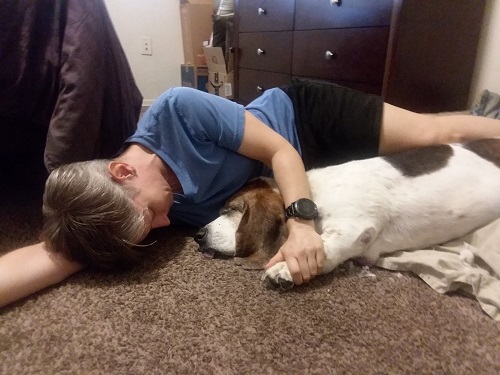
Dr. Campabadal slid a puppy pad under Rosie’s butt and showed herself out. I continued to scratch Rosie’s head as I cried. I hoped she knew I gave her the best life I could. I laid down next to her on the floor, petting her soft fur, watching her pink tongue turn a lavender gray. I sat and laid with her for about 90 minutes, and during that time, there was a shift where my brain understood that she was really gone. I think something about having this extra time with her made my grieving process easier.
Last Car Ride
Since I didn’t let the mobile vet take Rosie, I was responsible for getting her to the pet crematory. I’d picked out who our provider was going to be and given them a call the day before, so they knew we were coming.
In life, I made sure I was always strong enough to lift Rosie, but I knew I needed help getting her to the car. I called my neighbor Sarah (Rosie’s Aunt Sarah) to help. I learned the meaning of “dead weight” that day. It’s a completely different experience to lift your dog when she can’t hold herself up. Sarah helped me load Rosie against my shoulder and handled the opening and locking of doors between my bedroom and the car.
As I carried Rosie to the car with her paws flopping against my back with each step, I thought, “I hope none of my neighbors see me carrying my dead dog.” Thankfully, no one popped their head out at that moment. Sarah opened my back seat and help me gently lay Rosie across it. She was on her back with all her paws in the air.
Final Disposition
As I pulled into the pet crematory, I noticed there was a children’s playground directly across the street. Oh, the juxtaposition. The crematory operator was expecting me and rolled a cart to the car so we could easily transport Rosie inside.
I opted for what I call the “buddy cremation” where they put two animals in the machine at the same time. The fire is the same size every time they run the machine and doing two together is more energy efficient. Plus, as the operator said, it’s like they have a buddy in there. Each body is kept separate, so each family gets their own pet back.
The operator showed me what size Rosie’s urn would be. It seemed so small, but if humans are 60% water, then dogs probably are too.
I asked the operator when they’d cremate Rosie, and she said, “Probably today.” I thought, “So soon?!” but then my rational mind kicked in. This is what they do. There’s no reason to keep her in a refrigerator.
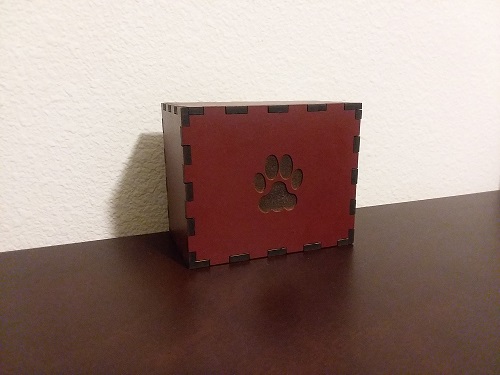
I got the call two days later that Rosie was ready to be picked up. The back of her urn has a sticker that says, “Rose Louise ‘Rosie’ belonging to the Carter family, Cremated on 08/07/2020.” For now, she sits on my dresser, but the plan is to sprinkle her at the beach when the COVID-19 pandemic is over.