Disclaimer: I am not a lawyer. I am a law student. In accordance with ABA policy, this blog should not be viewed as legal advice. It is simply my experiences, opinions, and stuff I looked up on the internet.
I took Criminal Procedure this semester to learn more about the legal implications of participating and planning flash mobs and pranks. While I was studying for my exam, I started to reflect back on Improv AZ’s encounter with mall security and the police last spring and if we should have done anything differently.
The stunt was simple – we had four agents wearing t-shirts that said “Coroner†across the front and back walk through a local mall carrying a stuffed fake body bag. The purpose was to see the reactions on people’s faces as they contemplated if what they were seeing was real or a joke. We were stopped and detained by security who called the local police. The police spoke with us briefly, mostly struggling to understand guerilla theatre, and released us without citation. Looking back, I think we could have done things differently.
When a police officer suspects that a person has committed or is about to commit a crime, they can conduct a Terry stop to briefly stop the person to ask what they are doing. They can also ask for identification. If they suspect that the person is armed and dangerous, the police can protect themselves by frisking them for weapons.  If the police find no evidence to create a reasonable suspicion that a crime has occurred or is about to occur, they can’t detain the person any longer.
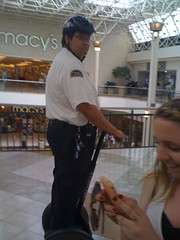
- Image by Mike_fj40 via Flickr
Mall security, however, are just people. They have a job to protect the interests of mall merchants and the safety of other mall patrons. It’s reasonable for them to confront suspicious behavior, but they have no more authority than Joe Blow Average. I remember from Torts class that when shoplifting has occurred, they can detain the shoplifter for a reasonable time until the police arrive. That’s a situation where the police know that a crime has occurred. I think there’s an argument that they don’t have this ability when they concerns about suspicious behavior.
In some states mall security have government authority, but this is the exception, not the rule. If they detain someone under the authority of their position without evidence of a crime, there’s an argument that they are impersonating a public servant or peace officer or committing unlawful imprisonment.  I think if we are stopped by mall security during a prank again, we will know that they can ask us questions within the scope of their employment, they can escort us off the private property, but without more than mere suspicion or dislike of our prank, we can probably keep walking if they try to detain us. We also do not have to show them identification. They can request it, but there’s no legal reason why we have to comply.
We have only been questioned by police once in the two years that Improv AZ has been in existence. We are very thoughtful about planning our pranks to be fun and lighthearted. The last thing we want to do is take the police away from fighting actual crime. However, if we are stopped by police again, we have to provide them identification – especially with the police being hyper-sensitive to illegal immigration. The police can Terry stop us and ask what we are doing. If the stop becomes a lengthy conversation, we can ask, “Am I free to go?†and if the police respond negatively, we can ask, “In what is this pursuant to?†and see if they can provide a valid reason for our continued detention. If we have purses or bags, the police can ask to search them, but without at least reasonable suspicion of a crime, we can respectfully decline their request.
I don’t want to give the impression that I am anti-police. On the contrary, I support the police preventing and fighting crime. I also support people exerting their Fourth Amendment rights. It’s very rare for the police to be summoned to the scene of a flash mob for legal or safety reasons, and it’s important when that happens, that participants know what rights they do and do not have.
Related articles
- ACLU sues city police over “stop and frisk” (philly.com)
- Email Privacy Is Protected By The 4th Amendment (lockergnome.com)



 Choices. This is probably the simplest and the most profound statements I carry with me.  It is absolutely true that a person’s existence is made up of the choices they make – where to go to school, what profession to enter, who to marry, what to do in frightening situations, etc. Who I am is what I do and what I do depends on the choices I make. This even applies to what I think about and where I put my energy. The best part of this lesson is the fact that in every situation, there is always a choice. Neither option may be desirable, but there is a choice nonetheless.